

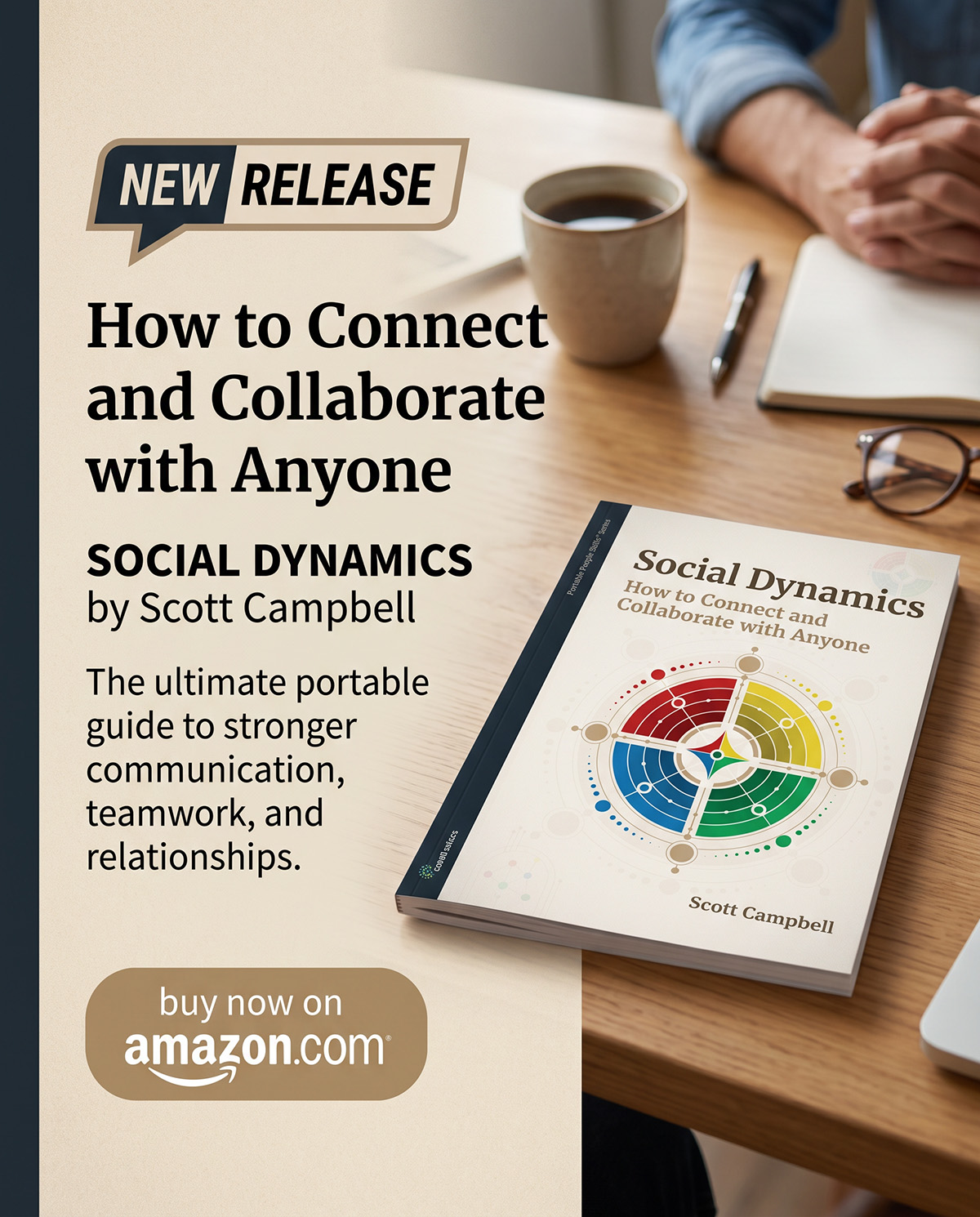
Social Dynamics: How to Connect and Collaborate with Anyone, a New Booklet by Scott Campbell from Core Factors
Social Dynamics - How to Communicate with Anyone
Social Dynamics, new booklet from Core Factors helps readers see why people approach work differently, gain support for their ideas and resolve conflict sooner.
When a person understands what a colleague is trying to achieve, the disagreement becomes a problem the two of them can solve together.”
TEMECULA, CA, UNITED STATES, October 28, 2026 /EINPresswire.com/ -- Core Factors, a people-development platform for coaches, consultants, and HR professionals, today published Social Dynamics: How to Connect and Collaborate with Anyone by Scott Campbell, M.Div. Campbell developed the Core Factors Social Dynamics model from decades of leadership consulting with organizations such as FedEx, Toyota, Siemens, and Bayer. The booklet teaches readers why people approach the same conversation, meeting, or decision in different ways, and how to adjust their own behavior so the people around them can hear and act on what they say. Readers who learn the model can gain more cooperation and commitment for their ideas, approach the people most different from them with greater confidence, and resolve disagreements before those disagreements cost time and trust. For practitioners, the booklet gives participants a way to keep applying Social Dynamics in their working relationships after a workshop or coaching session ends. Social Dynamics is the newest title in the Portable People Skills® series and is available in paperback from Amazon at $19.95 USD.— Kris Kiler, President Core Factors
Nearly everything a person accomplishes at work runs through other people. Each person brings a preferred outcome into every interaction that matters to them, and each person tends to assume the others want the same outcome. One colleague wants a decision today, another wants more information first, a third wants everyone in agreement, and a fourth wants a clear plan before anyone acts. When those priorities meet, each person reads the others' approach as delay, haste, or resistance. The cost appears in decisions that take three meetings, proposals that stall for lack of support, and disagreements that turn personal.
Most professionals accept that people differ. Far fewer can explain why a particular colleague frustrates them, or what to do differently in the next conversation with that colleague. Social Dynamics addresses the gap between knowing that people differ and knowing how to work with a specific difference.
For practitioners, this gap appears after the session ends. The conversations where Social Dynamics matters most take place in the weeks that follow, with colleagues who were absent from the room.
"Every difficult conversation at work involves two people pursuing an outcome each of them cares about," said Kris Kiler, Founder and President of Core Factors. "When a person understands what a colleague is trying to achieve, the disagreement becomes a problem the two of them can solve together. Scott built Social Dynamics around the core drive beneath each style, and understanding those drives changes how a person prepares for a meeting, presents an idea, and responds when a conversation turns tense. We published this booklet so participants can keep building that understanding after a workshop ends, and so practitioners can give clients a resource they return to each time they join a new team or work through a new conflict."
Social Dynamics gives readers a practical explanation for the friction they meet with other people, and a way to act on the explanation. Readers begin by confirming their own style through self-discovery, so the understanding they build rests on their own experience. A reader who understands the reasoning behind their own style can use their strengths deliberately and recognize the moments when they lean on those strengths too heavily.
The larger change comes in how readers work with others. A reader who understands what a colleague is trying to achieve can present an idea in terms the colleague values. The colleague then hears the message more easily, and the plan gains support. In a disagreement, the same reader can identify what each person wants from the outcome and shift their own behavior toward a resolution both people can accept. Interactions with the people most different from the reader become more predictable, and that predictability lowers the stress those interactions carry. Readers also learn to recognize when a role asks them to operate outside their own style, and that recognition helps them manage the stress of situations that run counter to their preferences.
Readers who lead others gain the same advantages at the scale of a team. A leader who understands the styles on a team can give feedback each person receives more easily, align roles and tasks with what motivates each team member, and help resolve a conflict when the people involved are unable to resolve the conflict themselves.
The effect of Social Dynamics extends outward from the individual reader. A person who resolves misunderstandings early protects the trust that working relationships depend on. A team whose members understand one another's styles draws on the full range of strengths in the group, and the team's decisions reflect more than one way of seeing the problem. An organization whose people can adapt to one another is better prepared when a reorganization arrives or a project changes direction, because change reaches people through conversations between colleagues who see the change differently.
For practitioners, the booklet extends the reach of their work. Participants keep a reference they can return to before an important conversation, and the language of the model gives a client words to describe what happened in a difficult interaction. When every participant in a cohort learns the same four styles, managers, facilitators, and team members can discuss working relationships in terms everyone recognizes. Because the understanding a person builds goes with them into each new role and team, the development a practitioner starts continues long after the engagement ends. The Portable People Skills series takes its name from that idea.
Social Dynamics: How to Connect and Collaborate with Anyone (Core Factors, 42 pages, paperback, $19.95 USD) is available from Amazon, and international Amazon marketplaces sell the booklet in local currency. Practitioners who design team development programs, facilitate leadership workshops, or coach clients on working relationships can put the booklet in participants' hands alongside the Social Dynamics assessment and the 28-page Style Navigator Report, or with readers who are new to the model. Practitioners can create a free Pro Account, or request a demo and take the assessment themselves before they put the assessment in front of a client. Facilitation of the Social Dynamics assessment requires the Social Dynamics Practitioner Foundation Training, a ten-module program led by Scott Campbell. Author interviews are available on request.
About the Author
Scott Campbell, M.Div., is the developer of the Core Factors Social Dynamics and Temperament Dynamics models. Both models draw on his decades of leadership consulting with organizations such as FedEx, Toyota, Siemens, and Bayer. Scott holds a Master of Divinity (M.Div.) in Organizational Leadership from Tyndale University. His continuing education includes certificates in Strategic Decision Making and Risk Management from Stanford University, Designing Solutions for Innovation and Strategy from Weatherhead School of Management, and Human Systems Dynamics. He is certified in the MBTI®, the Leadership Circle Profile®, the Leadership Culture Survey®, and the EQi® Emotional Intelligence Assessment. He is the author of Quick Guide to the Four Temperaments for Peak Performance: How to Unlock Your Talents to Excel at Work; Mind Games: 7 Tricks Your Brain Plays When Making Decisions; and NeuroEngagement: Using the Insights of Brain Science to Foster Employee Engagement. He is also the coauthor of 5-D Leadership: Key Dimensions for Leading in the Real World.
About Core Factors
Core Factors is a people-development platform for practitioners. Executive coaches, OD consultants, L&D professionals, HR professionals, and career practitioners use Core Factors to administer assessments, deliver results, reinforce development between sessions, and document outcomes through participant feedback and reporting.
The assessment portfolio includes Type Discovery, Type Elements, and Type Dynamics for psychological type work across decision-making, learning, leadership, and interpersonal effectiveness. EQ Accelerator guides emotional intelligence development with a structured focus on priority skills and growth sequencing. Social Dynamics addresses interaction styles and their applications across communication, collaboration, influence, and conflict. Career Path and Career Signals support career alignment through occupational fit mapping and values-based career planning. Brain Agility Lens supports development conversations focused on cognitive resources, agility, and the people skills they connect to.
Every assessment is supported by the Participant Hub. In the Participant Hub, participants access results, explore model content, engage with structured reflection, and receive developmental guidance from Evidentra®. Evidentra is the Core Factors AI Coach Assistant. Core Factors is built on a commitment to psychometric integrity, ethical application, and practical results for both the practitioner and the people they develop.
Kris Kiler
Core Factors
+1 844-989-5323
Visit us on social media:
LinkedIn
YouTube
Legal Disclaimer:
EIN Presswire provides this news content "as is" without warranty of any kind. We do not accept any responsibility or liability for the accuracy, content, images, videos, licenses, completeness, legality, or reliability of the information contained in this article. If you have any complaints or copyright issues related to this article, kindly contact the author above.
